

Suppliers
Contact Us
 GENTAUR Europe BVBA GENTAUR Europe BVBAVoortstraat 49, 1910 Kampenhout BELGIUM Tel 0032 16 58 90 45 Fax 0032 16 50 90 45 This email address is being protected from spambots. You need JavaScript enabled to view it.">This email address is being protected from spambots. You need JavaScript enabled to view it. |
 GENTAUR BULGARIA
53 Iskar Str. 1191 Kokalyane, Sofia
Tel 0035924682280
Fax 0035929830072
This email address is being protected from spambots. You need JavaScript enabled to view it." style="">This email address is being protected from spambots. You need JavaScript enabled to view it.
 GENTAUR France SARL
9, rue Lagrange, 75005 Paris
Tel 01 43 25 01 50
Fax 01 43 25 01 60
This email address is being protected from spambots. You need JavaScript enabled to view it." style="">This email address is being protected from spambots. You need JavaScript enabled to view it.
This email address is being protected from spambots. You need JavaScript enabled to view it." style="">This email address is being protected from spambots. You need JavaScript enabled to view it.
 GmbH Marienbongard 20
52062 Aachen Deutschland
Tel (+49) 0241 56 00 99 68
Fax (+49) 0241 56 00 47 88 This email address is being protected from spambots. You need JavaScript enabled to view it." style="font-family: Arial, Tahoma, Verdana, Helvetica; line-height: 15.59375px; ">
This email address is being protected from spambots. You need JavaScript enabled to view it." style="">This email address is being protected from spambots. You need JavaScript enabled to view it.
This email address is being protected from spambots. You need JavaScript enabled to view it." style="font-size: 12px; line-height: 1.3em;">
This email address is being protected from spambots. You need JavaScript enabled to view it." style="">This email address is being protected from spambots. You need JavaScript enabled to view it.
This email address is being protected from spambots. You need JavaScript enabled to view it.
 GENTAUR Ltd.
Howard Frank Turnberry House
1404-1410 High Road
Whetstone London N20 9BH
Tel 020 3393 8531
Fax 020 8445 9411
This email address is being protected from spambots. You need JavaScript enabled to view it." style="">This email address is being protected from spambots. You need JavaScript enabled to view it.
 GENTAUR Poland Sp. z o.o.
ul. Grunwaldzka 88/A m.2
81-771 Sopot, Poland
Tel 058 710 33 44
Fax 058 710 33 48
This email address is being protected from spambots. You need JavaScript enabled to view it." style="">This email address is being protected from spambots. You need JavaScript enabled to view it.
 GENTAUR Nederland BV
Kuiper 1
5521 DG Eersel Nederland
Tel 0208-080893
Fax 0497-517897
This email address is being protected from spambots. You need JavaScript enabled to view it." style="">This email address is being protected from spambots. You need JavaScript enabled to view it.
 GENTAUR SRL IVA IT03841300167
Piazza Giacomo Matteotti, 6, 24122 Bergamo
Tel 02 36 00 65 93
Fax 02 36 00 65 94
This email address is being protected from spambots. You need JavaScript enabled to view it.">This email address is being protected from spambots. You need JavaScript enabled to view it.
 GENTAUR Spain
Tel 0911876558
This email address is being protected from spambots. You need JavaScript enabled to view it." style="">This email address is being protected from spambots. You need JavaScript enabled to view it.
 Genprice Inc, Logistics
547, Yurok Circle
San Jose, CA 95123
Phone/Fax:
(408) 780-0908
This email address is being protected from spambots. You need JavaScript enabled to view it.

GENPRICE Inc. invoicing/ accounting:
6017 Snell Ave, Suite 357
San Jose, CA. 96123
 Serbia,
  Macedonia,
 Montenegro,
  Croatia:
Tel 0035929830070
Fax 0035929830072
This email address is being protected from spambots. You need JavaScript enabled to view it.">This email address is being protected from spambots. You need JavaScript enabled to view it.
 GENTAUR Romania
Tel 0035929830070
Fax 0035929830072
This email address is being protected from spambots. You need JavaScript enabled to view it.">This email address is being protected from spambots. You need JavaScript enabled to view it.
 GENTAUR Greece
Tel 00302111768494
Fax 0032 16 50 90 45
This email address is being protected from spambots. You need JavaScript enabled to view it.">This email address is being protected from spambots. You need JavaScript enabled to view it.
Other countries
Luxembourg +35220880274
Schweiz Züri +41435006251
Danmark +4569918806
Österreich +43720880899
Ceská republika Praha +420246019719
Ireland Dublin +35316526556
Norge Oslo +4721031366
Finland Helsset +358942419041
Sverige Stockholm +46852503438
Magyarország Budapest +3619980547


ELISA Plate Analyser - Micro Plate Read

ELISA Plate Analyser offered by Gentaur / GDMS is user friendly micro plate Analyser. It is compact & lightweight. It is designed to measure and interpret enzyme immunoassay results, both monochromatically and bichromatically.
It is intended for in vitro diagnostic use.
Special Features
The ELISA Plate Analyser can accommodate a flat bottom as well as a round configuration. The carriage is
designed in a way that the plate automatically moves smoothly and positions itself accurately in the
optical measurement path. Readings are taken continuously.The average value is calculated and
results are presented according to the option selected.
The ELISA Plate Analyseroperates on a WIDE voltage (90-270 volt). This eliminates the need for an
external voltage stabilizer.
The ELISA Plate Analyserhas a special provision, which allows it to be used even when a printer is not
available. Readings can be conveniently noted down manually, by using the PAUSE option.
The other special features of ELISA Plate Analyserare the following:
o Option of Lamp saving mode.
o Selection of both primary and secondary filters.
o Latest technology with battery back up for 250 tests with QC, more than 2500
result.
o Robust built in 52-column thermal printer with 384 stationary heads.
o Unique circuitry for long lamp life.
o Alphanumeric Patients ID entry.
o Editing of saved tests.
o Human machine user interface: Touch panel, Keypad
o Multi-standard curve up to 12 standard calibrations with one blank optional.
o Access to test by touch of key.
o Capability to connect to 80-column printer for direct report printout.
o Blank is optional.
o Setting of the Date and Time.
o Capable of storing, deleting and recalling tests.
o Multiple calibrator modes.
o Selection of duplicates for both calibrators and samples.
 Download Technical Sheet Specification
Price: 1880 €

Contacts:
Gentaur / GDMS Belgium
Voortstraat 49, BE – 1910 Kampenhout
Tel: 003222650921
e-mail: This email address is being protected from spambots. You need JavaScript enabled to view it.">This email address is being protected from spambots. You need JavaScript enabled to view it.
SensiFAST™ cDNA Synthesis Kit
Product description
This kit is the best option for customers wanting to generate cDNA ready for real-time applications. The Kit provides a rapid and very sensitive method for first strand cDNA synthesis for use in real -time PCR studies. The TransAmp™ Buffer provides highly optimized components for efficient reverse transcription and includes a unique blend of anchored oligo dT and random hexamer primers to ensure unbiased 3’ and 5’ coverage for enhanced data accuracy. An extremely efficient reverse transcriptase delivers highly robust first strand synthesis and higher cDNA yields from a wide range of input RNA concentrations. SensiFAST cDNA Synthesis Kit offers enhanced reproducibility, sensitivity and efficiency for exceptional performance in subsequent real-time PCR experiments.
| Feature: | Benefit: | Advantege: |
| Reproducible | Unique reverse transcriptase and new TransAmp™ buffer generate consistent first-strand cDNA |
Reduces the number of replicates the customer needs to do, saving space and cost |
| Broad dynamic range |
Ideal for dilute and low-copy samples | Improves assay sensitivity as abundant and rare transcripts can be run against each other |
| Sensitive | Real-Time RT-PCR analysis from as little as 4pg of starting total RNA |
Can be used even when starting material is limited |
| Unbiased cDNA synthesis |
Complete 5' to 3' RNA sequence representation |
Gives more accurate quantification of genes |
| Rapid | cDNA synthesis and real-time PCR in less than 60 minutes |
Allows higher throughput |
| Optimized | Designed to complement the SensiFAST SYBR and Probe kits |
Can be used directly in a real-time assay without further optimization needed |
Positioning
The SensiFAST cDNA Synthesis Kit has been optimized for real-time reactions, the new TransAmp Buffer contains reverse transcriptase enhancers that reduce complex RNA secondary structure, so that efficient reverse
transcription of all RNA samples, regardless of the complexity, can be achieved at 42° C, resulting in unparalleled reproducibility between samples.
| Cat. | Product | Price | Order |
| BIO-65053 | SensiFAST cDNA Synthesis Kit, 50 Reactions | 262 € |  |
| BIO-65054 | SensiFAST cDNA Synthesis Kit, 250 Reactions | 980 € | |
More: cDNA kits
MyTaq™ Blood-PCR Kit
Product description
The new MyTaq Blood-PCR Kit offers very fast, highly-specific, direct PCR from a wide range of human and animal whole blood samples. The novel buffer system replaces the need for complicated extraction or purification steps or use of additives. The advanced formulation of MyTaq Blood-PCR Kit allows fast cycling conditions to be used, without compromising PCR specificity and yield. The addition of an inert red dye in the mix also helps improve throughput. MyTaq Blood-PCR Kit has been specifically engineered to overcome PCR inhibitors typically present in blood samples, including anticoagulants (EDTA, citrate and heparin), to give significantly increased sensitivity and PCR success rates even with demanding applications such as GC-rich templates or longer amplicons. MyTaq Blood-PCR Kit significantly improves amplification success rates from human and animal whole blood samples. The speed and high specificity of MyTaq Blood-PCR Kit also makes it highly suited for multiplex PCR and high-throughput genotyping assays.
| Feature: | Benefit: | Advantege: |
| Extraction-free | Eliminate complex DNA extraction protocols | Faster and less expensive and reduces the risk of cross contamination of samples |
| Optimized buffer | Specially formulated to overcome blood inhibition for highest PCR success and sensitivity | Reduces the need for optimization and additional buffers |
| Versatile | Perfect for a wide range of human and animal bloods including EDTA, citrate and heparin preserved samples | A universal solution for all blood types |
| Powered by MyTaq HS | For highest specificity and yield | Higher yield gives higher sensitivity and speed gives higher throughput |
| Application validated | Ideal for multiplexing, GC rich templates and longer amplicons | A universal solution for all assays |
Positioning
The MyTaq Blood-PCR Kit has been optimized, the novel buffer that is better at dealing with inhibitors such as hemoglobin, hemin, lactoferrin, serum IgG, proteases, anticoagulants and salts, to give the highest PCR success and sensitivity.
| Cat. | Product name: | Price: | Purchase: |
| BIO-25053 | MyTaq Blood PCR Mix, 2x, 100 Rections | 124 € | |
| BIO-25054 | MyTaq Blood PCR Mix, 2x, 250 Reactions | 214 € | |
More: PCR kits
New Melanoma Panels
Each antibody for melanoma is available as a 2ml, 7ml, or 25ml ready-to-use antibody as well as in concentrated form. Perhaps the most exciting antibody is our pan Melanoma which contains four different clones in order to make the cocktail more sensitive and also more valuable as a diagnostic tool for metastatic melanoma.
Product List:
Melanoma; Pan (Concentrate) |
|||
 |
Species: Mouse Clones: MART-1; Clone M2-7C10, MART-1; Clone M2-9E3, Tyrosinase; Clone T311, Melanoma: HMB45. Isotype: Mouse IgG1 Species Reactivity: Human. Positive Control: Human Melanoma Specificity: HMB45 has been shown to be a very specific marker for melanomas. |
||
Melanoma; Pan (Ready-To-Use) |
|||
|
|
|
|
MART-1; Clones M2-7C10 & M2-9E3 (Ready-To-Use) |
|||
|
Species: Mouse Clones: M2-7C10 & M2-9E3 Isotype: Mouse IgG2b, kappa Species Reactivity: Human. Positive Control: Human Melanoma. Specificity: MART-1 has been shown to be a very specific marker for melanomas. |
|
|
MART-1; Clones M2-7C10 & M2-9E3 (Ready-To-Use) |
|||
|
Species: Mouse Clones: M2-7C10 & M2-9E3 Isotype: Mouse IgG2b, kappa Species Reactivity: Human. Positive Control: Human Melanoma. Specificity: MART-1 has been shown to be a very specific marker for melanomas. |
|
|
Tyrosinase; Clone T311 (Concentrate) |
|||
|
Species: Mouse Clone: T311 Isotype: Mouse IgG1 Species Reactivity: Human. Positive Control: Human Melanoma Specificity: Tyrosinase has been shown to be a very specific marker for melanomas, not cross reacting with other tumors or normal tissues tested. |
|
|
Tyrosinase; Clone T311 (Ready-To-Use) |
|||
|
Species: Mouse Clone: T311 Isotype: Mouse IgG1 Species Reactivity: Human. Positive Control: Human Melanoma Specificity: Tyrosinase has been shown to be a very specific marker for melanomas. Cross reactivity with other tumors or normal tissues tested has not been reported. |
|
|
MART-1; Clone M2-9E2 (Concentrate) |
|||
 |
Species: Mouse Clone: M2-9E2 Isotype: Mouse IgG2b, Kappa Species Reactivity: Human, Mouse, Rat. Positive Control: Metastatic melanoma in lymph nodes. Specificity: The clone M2-9E2 MART-1 antibody labels melanomas and other tumors showing melanocyte differentiation. |
|
|
MART-1; Clone M2-9E2 (Ready-To-Use) |
|||
|
Species: Mouse Clone: M2-9E2 Isotype: Mouse IgG2b, Kappa Species Reactivity: Human, Mouse, Rat. Positive Control: Metastatic melanoma in lymph nodes. Specificity: The clone M2-9E2 MART-1 antibody labels melanomas and other tumors showing melanocyte differentiation. |
|
|
MART-1; Clone M2-7C10 (Concentrate) |
|||
|
Species: Mouse Clone: M2-7C10 Isotype: Mouse IgG2b, Kappa Species Reactivity: Human. Clone M2-7C10 does not react with mouse or rat. Positive Control: Metastatic melanoma in lymph nodes. Specificity: The clone M2-7C10 MART-1 antibody labels melanomas and other tumors showing melanocyte differentiation. |
|
|
MART-1; Clone M2-7C10 (Ready-To-Use) |
|||
|
Species: Mouse Clone: M2-7C10 Isotype: Mouse IgG2b, Kappa Species Reactivity: Human. Clone M2-7C10 does not react with mouse or rat. Positive Control: Metastatic melanoma in lymph nodes. Specificity: The clone M2-7C10 MART-1 antibody labels melanomas and other tumors showing melanocyte differentiation. |
|
|
S-100, Clone 4C4.9 |
|||
| Species: Mouse Monoclonal Clone: 4C4.9 Isotype: IgG2a MW: 21-24 kD Species Reactivity: Human, Cow, Mouse Positive Control: Melanoma or Schwannoma. Specificity: Recognizes proteins of 21-24kDa, identified as the A and B subunits of S100 protein. S100 belongs to the family of calcium binding proteins such as calmodulin and troponin C. S100A is composed of an alpha and beta chain whereas S100B is composed of two beta chains. Antibody to S100 stains Schwannomas, ependymomas, astrogliomas, almost all benign and malignant melanomas and their metastases. S100 protein is also expressed in the antigen presenting cells such as the Langerhans cells in skin and interdigitating reticulum cells in the paracortex of lymph nodes. S100 protein is highly soluble and may be eluted from frozen tissue during staining. |
|
||
Melanoma; Clone HMB45 (Concentrate) |
|||
| Species: Mouse Clone: HMB45 Isotype: Mouse IgG1/ Kappa Species Reactivity: Human Positive Control: Human Melanoma Specificity: HMB45 has been shown to be a very specific marker for melanomas. |
|||
Melanoma; Clone HMB45 |
|||
| Species: Mouse Monoclonal Clone: HMB45 Isotype: IgG1 Species Reactivity: Human. Does not react with dog and rat. Positive Control: Melanoma Specificity: By immunohistochemistry, it specifically recognizes a protein in melanocytes and melanomas. Biochemical nature of its antigen is yet not fully characterized. This antibody reacts with junctional and blue nevus cells and variably with fetal and neonatal melanocytes. Intradermal nevi, normal adult melanocytes, and non-melanocytic cells are negative. It does not stain tumor cells of epithelial, lymphoid, glial, or mesenchymal origin. |
|
||
Click here for Prices!
PhysioSuite
The unit itself has a small footprint which allows for both the surgeon and monitoring technician to see the graph and digital readout, and does not require a computer for use.
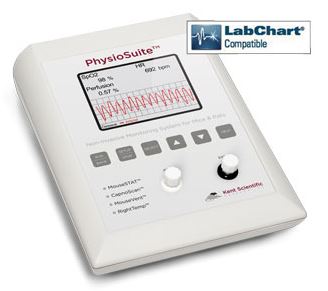
PhysioSuite Monitor
The PhysioSuite Monitor for mice and rats is a modular system that allows you to select the modules you need now, with the option to add more modules later. You can include up to four modules in one unit. The PhysioSuite significantly decreases the amount of space in the surgical area. The capacity of adding modules such as pulse oximetry & heart rate monitoring, artificial ventilation, ETCO2, temperature monitoring and homeothermic warming make the PhysioSuite even more space efficient. The built-in screen provides you with critical information that is easily visible and customizable. The real-time display screen has the capability to show numeric readings, waveforms, or both simultaneously. View historical data with the touch of a button.
MouseSTAT Pulse Oximeter and Heart Rate Monitor module
The MouseSTAT module does not need a computer to function. Though it was specifically designed for use on mice, with the proper sensor, it can be used on any size animal. Since the paws of small rodents are typically nude, no shaving or hair removal is required. Ideal for dark-skinned mice, such as C57BL6. Though some users apply the sensors to the tail, it is not recommended.
Pulse Oximeter Sensors:
The MouseSTAT Paw Sensor for mice (MSTAT Sensor-MSE) was specifically designed for small laboratory animals. It uses a miniature LED and light sensor to transmit and receive the red and infrared light that are proportional to the size and translucence of the small laboratory paw. One is included with every MouseSTAT module.
The larger MouseSTAT Y-style sensor (MSTAT Sensor-RAT) is ideal for penetrating thicker tissue, such as that on a rat or larger animal. It can be used on any animal and on any appendage with sufficient vascularization and irrigation. This can be a mouse paw, but more commonly is a rat paw, rabbit ear or small animal tongue.

Other small laboratory animal pulse oximeters use human-size sensors mechanically adapted for small animals. These adapted human-sized sensors have large LEDs and light sensors that were designed to work on a human index finger or other like appendages. The large LEDs flood a boney appendage such as a finger with a tremendous amount of light, which is mostly absorbed or blocked by the bones and connective tissue. Since only a small amount of light passes through a finger, a large sensor is required to attempt to collect as much of the minute amount of transmitted light as possible.
When the human-sized sensors are attempted to be used on a translucent small laboratory animal paw, there is too much light delivered, which overflows the large light sensor. Therefore, the adapted human pulse oximeter sensors from other manufacturers need to use thick sections of the small laboratory animal body that approximate a human finger, such as the neck or thigh. Placing the sensor in these locations typically requires the extra effort of shaving the area. The higher force spring in the sensor clips may cause ischemia in the sensing area from the continuous squeezing pressure.
Other pulse oximetry systems also require a dedicated external PC to operate, which take up valuable lab bench and surgical area space.
MouseVent Automatic Ventilator moduleFully Automatic - Enter animal's weight and press RUN!
- Neonatal Mice to 500g rats
- Pressure and Volume Controlled
- Built-in Display - No need for a separate computer
The MouseVent is a fully automatic ventilator for both mice and rats. Enter the animal's weight and the ventilator automatically sets the respiratory rate and tidal volume. It also includes additional features such as:
- Auto Sigh
- Auto PEEP
- Automatic Respiratory Assist Mode
The built-in display provides information about the current ventilator settings as well as physiological parameters of the animal. You have the ability to customize the display; many of the parameters can easily be displayed as numeric numbers or on a real-time graph. You can view the last 5 readings under the History view.

In addition to being a fully automatic ventilator, functions can be added on to MouseVent to fit your research needs. Available add-ons include:
All of the above can be combined into one PhysioSuite system – 1 box – eliminating the need for multiple boxes and systems.
RightTemp Temperature Monitoring and Homeothermic Control module
The RightTemp Temperature Monitoring and Homeothermic Control module is a complete kit that allows you to accurately monitor and maintain animal core body temperature. Simply set your desired core body temperature and the system will automatically control the warming pad so the animal's core temperature never goes above or below your set temperature.
Included with the RightTemp are two warming pads and two temperature sensors. The pads are 14" x 14" and 6" x 8", both ideal for mice, rats, and other small animals.
Multi-functional controller gives you 3 options for use:
-
Control/maintain core body temperature by using both sensors
-
Set desired pad temperature using the pad sensor only
-
Adjust pad temperature by changing the percentage of power to the pad using no sensors
Features of the RightTemp Animal Warming module:
- Warm with or without sensors
- Configure up to 5 alarms
- Customize display
- Chart and view temperature readings for both pad and animal
- See the last 5 readings on the main screen
- Upload data to your computer
- Output data for use with strip chart software
About Far Infrared (FIR) Warming
The pads warm the animal through far infrared (FIR) warming. Far infrared light is absorbed by cells deep within the body of the animal which safely raise the core body temperature. FIR light warms the body without warming the air between the FIR source and the body. FIR is totally safe; in fact, 80% of the sun’s rays are in the low energy, far infrared range. FIR waves resonate with organic matter and penetrate deep into the body. The energy level of water in the body’s cells is gently increased through “resonant absorption” warming the inside of the body. The body can absorb as much as 90% of FIR heat compared to only 20% with conventional warming pads. Studies have shown that FIR can maintain therapeutic temperatures longer when compared with conventional heating methods. Less warming is required with FIR than with conventional techniques. FIR allows researchers to safely warm animals for a longer period of time without unknowingly overheating the animal. Your animal can now be warmed over an extended period of time without having to constantly increase the temperature.
FIR warming increases body metabolism, thereby discharging anesthetics and toxins, which aid in faster recovery from surgery.
| Product # | Description | #/Box | Price | Purchase |
| PS-RT | PhysioSuite with RightTemp Temperature Monitoring and Homeothermic Control | 1 | 2.405 Euro | |
| PS-MSTAT | PhysioSuite with | 1 | 6.045 Euro | |
| MouseSTAT Pulse Oximeter | ||||
| and Heart Rate Monitor | ||||
| FREE RightTemp module included, an $1,850 value! | ||||
| PS-CO2 | PhysioSuite with CapnoScan End-Tidal CO2 Monitor | 1 | 6.045 Euro | |
| FREE RightTemp module included, an $1,850 value! | ||||
| PS-MVG | PhysioSuite with MouseVent Automatic Ventilator | 1 | 6.305 Euro | |
| FREE RightTemp module included, an $1,850 value! | ||||
| PS-MSTAT-CO2 | PhysioSuite with MouseSTAT and CapnoScan | 1 | 12.090 Euro | |
| FREE RightTemp module included, an $1,850 value! | ||||
| PS-MVG-MSTAT | PhysioSuite with MouseVent Automatic Ventilator and | 1 | 12.350 Euro | |
| MouseSTAT Pulse Oximeter with Heart Rate Monitor | ||||
| FREE RightTemp module included, an $1,850 value! | ||||
| PS-MVG-CO2 | PhysioSuite with MouseVent and CapnoScan | 1 | 12.350 Euro | |
| FREE RightTemp module included, an $1,850 value! | ||||
| PS-MSTAT-CO2 | PhysioSuite with MouseSTAT and CapnoScan | 1 | 12.090 Euro | |
| FREE RightTemp module included, an $1,850 value! | ||||
| PS-MVG-MSTAT | PhysioSuite with MouseVent and MouseSTAT | 1 | 12.350 Euro | |
| FREE RightTemp module included, an $1,850 value! | ||||
| PS-MVG-MSTAT-CO2 | PhysioSuite with MouseVent G500, MouseSTAT and CapnoScan | 1 | 18.395 Euro | |
| FREE RightTemp module included, an $1,850 value! | ||||
 MSTAT Sensor-MSE MSTAT Sensor-MSE |
Mouse Paw Pulse Oximeter Sensor | 1 | 457.5 Euro | |
| (one is included with the purchase of the MouseSTAT module) | ||||
 MSTAT Sensor-RAT MSTAT Sensor-RAT |
Rat Paw Pulse Oximeter Sensor | 1 | 457.5 Euro | |
| EXT-BATTERY | External Battery, allows for up to 6 hours of operation, depending on which modules are in-use. | 1 | 262.5 Euro | |
More: PhysioSuites
Geraniol (CAS #: 106-24-1)

Chemical Formula: C10H19O
CAS #: 106-24-1
Availability: Request a quote only
Boil Point: 229-230
Molecular Weight: 154.25
Hazard Information: Not D.O.T. -Regulated
Price: 155 Euro for 50g / 370 Euro for 250g
* Prices are without VAT
** For research use only.
*** For artificial perfume use, the mentioning of synthetic geranial as ingredient is obligatory on the package
More: Geraniol
Rokepie S01 (2 and 10 ML)


Quick product overview
• It is designed as a for standard well-defined cell culture medium, not as a replacement
• The ease of use is to add to cells, incubate and cool cells.
• After reaching 37°C growth is directly supported, no need for directly replacing storage solution.
• A tool of time management in cell culture.
• Rokepie reduces cell damage caused by cold.
Details
Research in the field of hibernation and its protective mechanisms led to the development of several novel chemical entities, designed to activate dormant protective mechanisms against the damage induced by hypothermia and subsequent rewarming. This product is designed to be used in your personal, well defined and cell-specific cell culture medium. Whereas other commercially available storage solutions completely replace cell culture medium, Rokepie-S01® is simply an addition. Another benefit is that your cell culture medium immediately supports growth of viable cells after cold storage, without the need to remove the storage solution and apply fresh cell culture medium.
Products:
Rokepie S01 2 ML - 250 €
Rokepie S01 10 ML - 995 €
*Prices are without VAT
AccuPower samples available!
| Cat. | Product | Price | Order |
| D-1020 SM | 25/100 bp mixed DNA ladder | 5 € | |
| D-1040 SM | 1kb DNA Ladder | 5 € | |
| K-2631 SM | AccuPower ProFi Taq PCRpremix | 5 € | |
| K-2611 SM | AccuPower PyroHotstart Taq PCR premix | 5 € | |
| K-2301 SM | AccuPower Hotstart Pfu peR PreMix | 5 € | |
| K-2101 SM | AccuPower RocketScript RTPremix | 5 € | |
| K-2501 SM | AccuPower RocketScript RT-PCR premix | 5 € | |
| K-6704 SM | AccuPower Dual-HotStart RT-qPCR premix | 5 € | |
| K-6251 SM | AccuPower 2X GreenStar qPCRMaster Mix | 5 € | |
| K-6210 SM | AccuPower GreenStar qPCR PreMix | 5 € | |
| K-6100 SM | AccuPower DualStar qPCR PreMix | 5 € | |
More: AccuPower
MRC-5 culture media
Gentaur product and conditioning cells in laboratory culture
- MRC5 - VERO-McCoy - HEP2
- Possible packaging: frozen cells bulbs, ready cells
in vials or tubes
- Culture media Employment


| Designation | Ref. | Conditioning |
| Cells | ||
| MRC 5: human diploid cells - Lung (10 ampoules of 10 M fcetus |
84003c |
Frozen cells, 5 x 1 ml (5 bulbs 10 million cells min.) |
| 84003c10 | Frozen cells. 10 x 1 ml (10 ampoules of 10 M cells min.) |
|
| 84002 | Cells in suspension. 30 ml (30 ML cells min.) |
|
| 84003 | Cells in suspension. 10 ml (10 ML cells min.) |
|
| VERO: Cells African green monkey kidney | 84005 | Cells in suspension. 10 ml (10 ML cells min.) |
| 84009 | Cells in suspension. 30 ml (30 ML cells min.) |
|
| Mac COY: Fibroblasts from mice | 84008 | Cells in suspension. 10 ml (10 ML cells min.) |
| 84010 | Cells in suspension. 30 ml (30 ML cells min.) |
|
| Hep 2 human laryngeal carcinoma cells | 84013 | Cells in suspension. 10 ml (10 ML cells min.) |
| 84011 | Cells in suspension. 30 ml (30 ML cells min.) |
|
| Culture media Employment | ||
| Growth medium for MRC·5(10%SVF) | M0430c | 10 x 125 ml |
| Maintenance medium for | M0431E | 10 x 100 ml |
More: Culture media
FLICA® 660 Caspase 3/7 Assay Kit, far-red fluorescence
Caspase-3 Assay for Apoptosis Detection in Whole, Living Cells
Catalog no. 9125 (25-50 tests)
 Apoptosis is an evolutionarily conserved form of cell suicide mediated by a cascade of proteolytic enzymes called caspases. Pro-apoptotic signals activate the enzymatic cascade resulting in the cleavage of protein substrates, leading to the disassembly of the cell. Caspases have been identified in organisms ranging fromC. eleganstoMembers of the mammalian caspase family of cysteinyl aspartate-specific proteases play distinct roles in apoptosis and inflammation.
Caspases
Active caspase enzymes exhibit catalytic and substrate specificities comprised of short tetra-peptide amino acid sequences that must contain an aspartate in the P1 position. These preferred tetra-peptide sequences have been used to derive peptides that specifically compete for caspase binding. In addition to the distinctive aspartate cleavage site at P1, the catalytic domains of the caspases typically require four amino acids to the left of the cleavage site with P4 as the prominent specificity-determining residue. Addition of a fluoromethyl ketone (FMK) to the tetrapeptide results in an irreversible linkage and permanent inactivation of the cysteine protease enzyme. Furthermore, conjugation of a fluorescent moiety at the amino terminus yields a probe that allows for the detection of caspase activity.
FLICA® 660 Caspase-3 Assay: Detection Mechanism
The far-red FLICA® 660-DEVD-FMK caspase-3 detection probe is comprised of the preferred affinity peptide sequence (DEVD) targeted by activated caspase-3 and caspase-7, a far-red fluorescent 660 dye label, and a fluoromethyl ketone (FMK) reactive moiety. The resulting fluorescent caspase-3 inhibitor probe forms an irreversible, covalent bond with active caspase-3 enzymes, efficiently labeling the target for detection. Due to its cell permeant nature and fluorescence properties, the far-red FLICA caspase-3 detection probe enables whole cell analysis via common fluorescence detection methods.
To use FLICA Caspase-3 Assay, add the caspase-3 detection probe directly to suspension cell or tissue culture media, incubate, and wash. The cell permeant, far-red FLICA caspase-3 detection probe will efficiently diffuse into cells and irreversibly bind to activated caspase-3 enzymes, thereby retaining the red signal inside caspase-3-positive cells. Cells not bearing active caspase-3 return to a non-fluorescent status after the wash step.
The FLICA® 660 caspase-3 detection probe has an optimal excitation at 660 nm and optimal emission range from 680-690 nm. As such, it has demonstrated excellent excitation efficiency with a conventional red HeNe laser with a 633 nm excitation, enabling samples to be analyzed with most flow cytometers and fluorescence microscopes equipped with electronic grey scale image capabilities. Cells labeled with the FLICA® caspase-3 detection probe may be read immediately or preserved for 16 hours using the fixative.
Cat #: 9125 (25-50 tests)
Price: 250 Euro (without VAT)


